Potato Laser Engrave File: A Comprehensive Guide to Digital Craftsmanship
In the rapidly evolving world of digital fabrication and laser engraving, the quality of your source file is just as critical as the precision of your machine. Among the vast array of available assets, the Potato Laser Engrave File has emerged as a versatile and highly sought-after resource for creators ranging from hobbyists to professional manufacturers. This unique design leverages high-resolution grayscale imagery to transform a humble subject into a striking piece of art suitable for a multitude of applications.
Understanding how to effectively utilize this specific type of digital asset can elevate the finish of your projects, ensuring that every cut and etch reflects professional-grade detail. This guide explores the features, technical specifications, and practical applications of this PNG-ready print file, helping you determine if it fits your creative workflow.
The Anatomy of a High-Quality Laser Engrave File
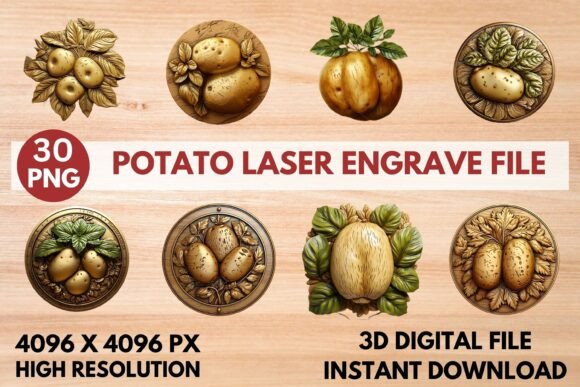
When discussing laser engraving, particularly with CO2 or diode lasers, the distinction between vector lines and raster images is fundamental. The Potato Laser Engrave File falls squarely into the raster category. Unlike SVG files which define paths and shapes using mathematical coordinates, this asset relies on pixel data to convey depth, texture, and shading. Specifically, it utilizes 4096 x 4096 px resolution, providing an abundance of pixel density that allows for intricate details without becoming pixelated when scaled down for smaller items like jewelry tags or coasters.
The core of this file set lies in its dual-format approach. Buyers receive a ZIP archive containing two distinct types of PNG files:
- 15 Coloring PNG Files: These transparent background images allow users to apply custom colors or textures before sending them to the laser, offering flexibility for those who wish to modify the visual tone.
- 15 Grayscale PNG Files: These are optimized specifically for direct laser interpretation. By using varying shades of gray, the laser modulates its power output to create smooth transitions between light and dark areas, resulting in photorealistic or artistic tonal effects.
This structure ensures that whether you prefer a monochromatic wood burn or a color-enhanced aesthetic, the foundation of the image remains sharp and clean. The non-editable nature of these PNGs guarantees consistency; what you see is exactly what will be engraved, preventing accidental distortions that can occur with editable vector layers.
Technical Specifications and Machine Compatibility
One of the primary concerns for laser operators is compatibility. Modern laser software varies significantly in how it interprets grayscale data. Fortunately, the Potato Laser Engrave File is engineered to perform well across major platforms, including Lightburn, xTool, Glowforge, Sculpfun, and standard CO2 systems.
For users operating within Glowforge, the recommended settings focus on maximizing contrast and speed. Setting the speed to 1000 and power to 90 allows the machine to process the grayscale values efficiently. Using the "Grayscale Vary Power" mode at a maximum quality setting of 270 LPI (Lines Per Inch) ensures that the dots placed by the laser are fine enough to blend seamlessly to the human eye. Notably, no masking is required, simplifying the setup process for quick production runs.
For those utilizing Lightburn, the approach shifts slightly to leverage dithering algorithms. It is highly recommended to use the Jarvis dither method for optimal engraving results. Dithering converts grayscale images into patterns of black and white dots, simulating intermediate shades. Because the provided PNG is already high-resolution, the dithering algorithm has ample data to work with, producing smooth tone transitions that mimic the organic texture of the potato theme. This makes the grayscale PNG the preferred choice for achieving realistic depth in wood or acrylic.
Practical Applications and Creative Versatility
The beauty of this design lies in its thematic neutrality combined with detailed execution. While the subject is a potato, the artistic rendering allows it to function as abstract art, rustic decor, or whimsical illustration. This versatility opens up numerous avenues for commercial and personal use.
Home Décor and Wooden Crafts
Wood is perhaps the most natural medium for laser engraving due to the carbonization effect that creates dark marks on lighter substrates. The Potato Laser Engrave File shines on cutting boards, serving trays, and wall art. The high contrast achievable with the grayscale version highlights the grain of the wood, creating a harmonious blend between the material and the design. For lighter woods like maple or birch, the results are particularly striking, as the laser burns appear crisp and defined against the pale background.
Textiles and Fashion Prints
Beyond hard materials, this file can be adapted for textile printing. If you are using a dye-sublimation printer or a direct-to-garment system, the high-resolution PNG serves as an excellent template. The transparent background of the coloring PNGs allows designers to place the potato motif on t-shirts, tote bags, or aprons without worrying about white borders interfering with the fabric’s color.
Stationery and Packaging
For small business owners, branding is key. The unique aesthetic of this file can be used on product packaging, gift tags, or stationery sets. The detailed line work adds a touch of sophistication, making simple items feel premium. Whether labeling artisanal food products or creating branded notebooks, the file provides a professional finish that resonates with consumers looking for handcrafted authenticity.
Evaluating Suitability and Limitations
While the Potato Laser Engrave File offers significant advantages, it is important to understand its limitations to manage expectations correctly. First and foremost, this is not a cutting file. There are no vector outlines for blade cutters to follow. If your project requires both engraving and precise cutting, you will need to create or purchase a separate SVG outline to match the dimensions of the engraving area.
Additionally, because the file is provided as a PNG set, it is not editable in terms of modifying the internal shapes or lines. You cannot add text directly onto the design layers or alter the potato’s contours within the file itself. However, this is also a strength for many users, as it eliminates the risk of breaking complex vector nodes during editing. You can resize the file as needed for specific products, but it is best practice to scale down rather than up to maintain image integrity.
Another consideration is the substrate. As noted in the Glowforge recommendations, the best results are achieved on lighter woods. Darker woods may absorb too much of the laser energy, causing the engraved areas to blend into the natural color of the material, reducing contrast. Similarly, while acrylics respond well to laser engraving, the effect may differ depending on the type of acrylic (cast vs. extruded), so testing on scrap pieces is always advised.
Conclusion
The Potato Laser Engrave File represents a thoughtful intersection of artistic design and technical optimization. By providing high-resolution grayscale and coloring options, it caters to a wide range of laser technologies and creative preferences. Whether you are a seasoned pro looking to streamline your workflow or a beginner eager to explore the nuances of raster engraving, this file set offers a reliable path to professional-looking results.
Remember to respect the intended use case: treat it as a digital asset for engraving, not a physical product, and prepare for instant delivery via ZIP file. With proper machine settings—such as Jarvis dithering in Lightburn or adjusted power levels in Glowforge—you can unlock the full potential of this unique design. Embrace the simplicity and elegance of the potato theme, and watch as your laser projects gain a new level of detail and character.